NDIS Home Cleaning Services: The Ultimate Solution for a Fresh, Clean Home
Keeping a home clean can become difficult when a disability affects mobility, energy, coordination, or the ability to manage everyday household tasks. For eligible NDIS participants, NDIS home cleaning services can provide practical assistance with household activities while supporting a person’s ability to live safely and independently at home.
However, NDIS cleaning support is not automatically available to every participant or every household. The type of assistance you can use depends on your individual plan, goals, funding arrangements, and the NDIS rules that apply to your circumstances.
This guide explains how NDIS home cleaning support works, what cleaning tasks may be included, how funding and provider requirements differ, what to look for when choosing a cleaner, and how to arrange services that fit your needs.
What Are NDIS Home Cleaning Services?
NDIS home cleaning services are household assistance that may help an NDIS participant manage cleaning and other everyday tasks when those tasks are affected by their disability.
The NDIS identifies cleaning as an example of an everyday household activity that may be supported through appropriate funding. The exact support available depends on the participant’s individual circumstances and plan. In many cases, household assistance sits within the broader area of assistance with daily life.
The purpose is not simply to provide a conventional domestic cleaning service. The support should relate to the participant’s disability-related needs and the goals or supports covered by their NDIS plan.
For broader information about home-based support, you can also explore home health services and in-home care.
What Cleaning Tasks Can NDIS Home Cleaning Support Include?
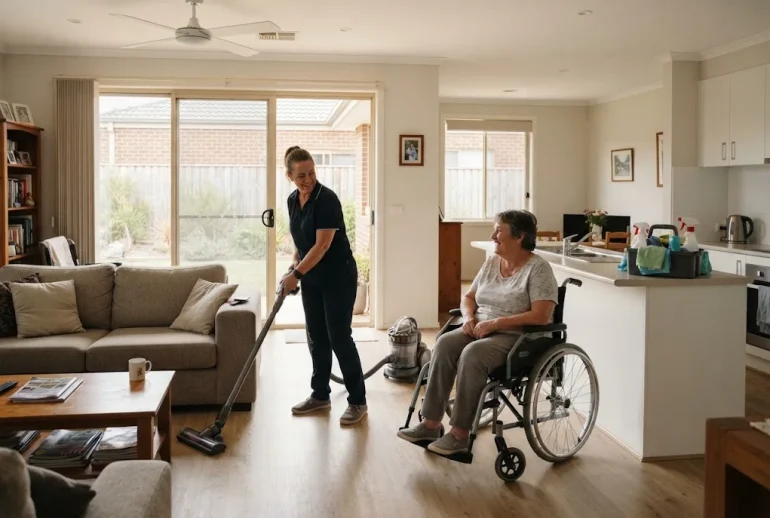
The exact tasks depend on the participant’s needs and the agreed service. Common household cleaning activities can include:
- Vacuuming and mopping floors
- Dusting accessible surfaces
- Cleaning bathrooms and toilets
- Wiping kitchen surfaces
- Cleaning commonly used living areas
- Changing bed linen where this forms part of the agreed household assistance
- Basic household tidying connected with the participant’s daily living needs
- Other routine household tasks that are appropriate to the participant’s circumstances
A provider should discuss the participant’s requirements before services begin rather than assuming that every task is included. Tasks involving hazardous materials, major property maintenance, extensive outdoor work, or specialist cleaning may fall outside ordinary household assistance and may require a different type of service.
Is Home Cleaning Covered by the NDIS?
Cleaning is not automatically funded for every NDIS participant. The NDIS states that Core Supports can help with everyday activities, and assistance with daily life may include household tasks such as cleaning when the support is appropriate to the participant’s needs and plan.
This means participants should check their current plan and funding arrangements before booking a service. A cleaning company cannot make a service NDIS-funded simply by describing itself as an NDIS cleaning provider.
The important question is whether the requested support is an appropriate disability-related support that can be purchased using the participant’s available funding.
For more information about using NDIS funding, see our related guide to home care and compassionate support services.
How NDIS Funding Management Affects Your Choice of Cleaner
One of the most important considerations when choosing an NDIS cleaning provider is how your NDIS funding is managed.
NDIA-Managed Funding
If your plan is NDIA-managed, you generally need to use an NDIS-registered provider for NDIS supports. This is different from self-managed and plan-managed arrangements.
Self-Managed Funding
Participants who self-manage their funding can generally choose registered or unregistered providers, provided the support is otherwise permitted under their plan and the relevant NDIS rules.
Self-management also involves keeping appropriate records and making claims for eligible supports.
Plan-Managed Funding
With plan-managed funding, participants can generally choose registered or unregistered providers, subject to the applicable NDIS requirements. A plan manager handles payment of provider invoices.
Because funding arrangements can affect provider eligibility and payment processes, it is worth confirming the details with your plan manager or NDIS contact before starting a new cleaning arrangement.
Benefits of NDIS Home Cleaning Services
1. Support With Everyday Household Tasks
Cleaning can involve repeated bending, lifting, reaching, standing, walking, or moving around the home. For someone whose disability makes these activities difficult, appropriate household assistance can reduce the practical burden of maintaining a living space.
2. More Independence at Home
The goal of disability-related support is not simply to take over every household responsibility. Depending on the participant’s goals, support workers can also help people develop skills and independence in everyday activities.
For some participants, this may mean receiving direct assistance. For others, support may involve learning ways to manage household tasks more safely or efficiently.
3. A More Manageable Living Environment
Regular household cleaning can make everyday living easier to manage. Keeping frequently used spaces organized and maintained can also reduce obstacles and make routine activities more practical.
4. Flexible Support Based on Individual Needs
Every participant has different circumstances. A person who can manage light cleaning independently may need assistance with heavier or physically demanding tasks, while another participant may require broader household support.
A good provider should therefore discuss the participant’s needs rather than applying exactly the same cleaning routine to every home.
How to Choose the Right NDIS Cleaning Provider
Finding a suitable provider involves more than searching for the cheapest cleaning service. The provider should understand your support requirements, funding arrangement, preferences, and agreed service expectations.
Check Provider Registration Requirements
First, determine whether you need a registered provider. If your funding is NDIA-managed, registered providers are required for NDIS supports. Participants with self-managed or plan-managed funding can generally use either registered or unregistered providers, although exceptions apply to some types of supports.
Ask About Experience With Disability Support
A cleaner entering a participant’s home should understand professional boundaries, privacy, communication, and the importance of following the participant’s preferences.
Ask prospective providers how they work with people with different accessibility requirements and how they adapt their service when a participant has particular needs.
Discuss the Exact Cleaning Tasks
Before agreeing to a service, clarify which rooms and tasks are included. A written service agreement can help avoid misunderstandings about the frequency, scope, price, and responsibilities of the service.
Ask About Pricing and Invoicing
NDIS pricing arrangements set out information about appropriate and reasonable maximum prices for NDIS supports. The applicable price can depend on the support and circumstances, including location.
Ask the provider how charges will be calculated and how invoices will be handled under your particular funding arrangement.
Consider Communication and Reliability
Consistent communication matters when someone relies on household assistance. Before choosing a provider, consider whether they respond clearly, arrive as agreed, explain changes in advance, and provide an easy way to raise concerns.
What to Discuss During Your First Cleaning Assessment
A first meeting or assessment is a useful opportunity to establish expectations. Consider discussing:
- Which rooms require regular cleaning
- Which cleaning tasks are most difficult for you
- How often you need assistance
- Preferred days and times
- Accessibility considerations inside the home
- Preferred cleaning products or methods
- Any areas that require special attention
- How changes or cancellations will be handled
- How the provider will invoice or claim for the service
- Who to contact if there is a problem
Clear expectations from the beginning can make the ongoing relationship much easier for both the participant and provider.
NDIS Cleaning Services vs. Standard House Cleaning
There can be an important distinction between ordinary domestic cleaning and disability-related household assistance.
A standard cleaning company generally focuses on cleaning outcomes: floors, bathrooms, kitchens, dusting, and other household tasks. NDIS-funded support must additionally fit within the participant’s eligible disability-related supports and funding arrangements.
This is why participants should not assume that any commercial cleaning service can automatically be paid through their NDIS plan.
The focus should remain on the participant’s needs, goals, funding and the rules governing the particular support.
How to Arrange NDIS Home Cleaning Services
Once you understand your funding arrangement and cleaning requirements, the process can be straightforward.
- Review your NDIS plan: Check the funding available for relevant everyday support and make sure the proposed service aligns with your plan.
- Identify suitable providers: Research local providers and check whether their registration status matches your funding requirements.
- Compare services: Ask about tasks, frequency, pricing, availability, communication and invoicing.
- Discuss your needs: Explain the disability-related difficulties that affect your ability to manage household cleaning.
- Agree on the service: Establish the scope of work and payment arrangements before services begin.
- Review the arrangement: If your circumstances change, discuss whether the service still meets your needs and fits within your available funding.
The NDIS recommends researching providers, considering recommendations and checking provider information before making a choice. Participants can also use the NDIS Provider Finder to locate registered providers.
Questions to Ask an NDIS Cleaning Provider
Do I need an NDIS-registered cleaning provider?
It depends on how your NDIS funding is managed and the type of support involved. NDIA-managed funding generally requires registered providers, while self-managed and plan-managed participants can generally choose registered or unregistered providers, subject to specific exceptions.
Does the NDIS pay for all household cleaning?
No. Cleaning is not automatically funded for every participant. The support must be appropriate to the participant’s disability-related needs and funding arrangements.
Can I choose my own cleaning provider?
Participants generally have choice over providers within the rules that apply to their funding arrangement. Your plan manager, support coordinator or NDIS contact can help clarify your options.
Can cleaning be scheduled regularly?
Regular services may be possible when they are appropriate to the participant’s needs and funding. The frequency should be agreed with the provider and managed within the available budget.
What if my cleaning needs change?
Discuss changes with your provider and, where necessary, your plan manager, support coordinator or NDIS contact. A service arrangement should reflect your current needs and the supports you are actually able to use under your plan.
Final Thoughts on NDIS Home Cleaning Services
NDIS home cleaning services can provide valuable practical assistance for participants who have difficulty managing household tasks because of disability-related needs. The biggest benefit is not simply having a cleaner; it is having appropriate support that fits within the participant’s goals, funding arrangement and everyday life.
Before booking a service, confirm what your plan allows, understand whether you need a registered provider, compare providers carefully, and agree on the exact tasks and payment arrangements. Taking these steps can help you find household assistance that is reliable, appropriate and easier to manage over time.
For readers exploring other healthcare and home-support topics, our coverage of home health services and healthcare coding provides additional background on how home-based healthcare systems operate.