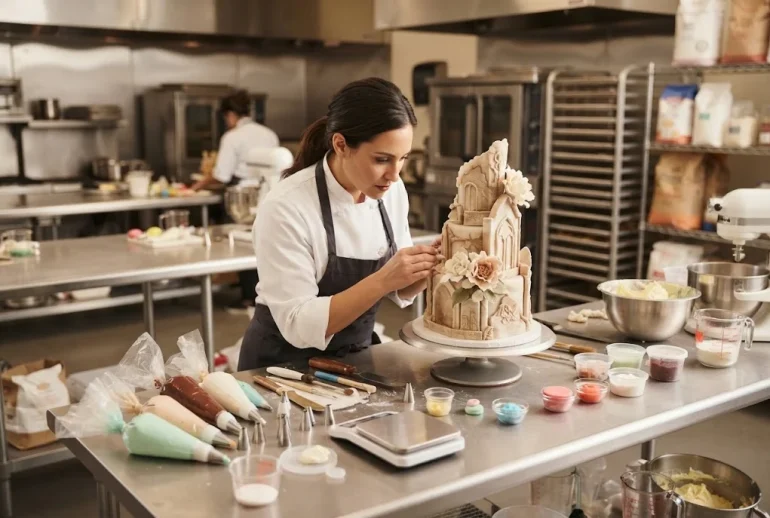
For readers interested in how a chef turns creativity into a professional career, Goldman’s journey offers a useful example. His education shows that culinary success can come from combining structured training with practical experience, artistic skills, discipline, and a willingness to keep learning.
What Did Duff Goldman Study?
Duff Goldman attended the University of Maryland, Baltimore County, where he completed his undergraduate studies. After college, he chose to specialize further in baking and pastry rather than pursuing another traditional four-year degree.
He attended the Culinary Institute of America at Greystone in California’s Napa Valley and earned a certificate in Baking and Pastry Arts. The specialized program gave him focused training in professional pastry techniques and helped prepare him for work in commercial kitchens and high-level culinary environments.
This distinction is important when researching Duff Goldman education. His culinary qualification was a specialized certificate rather than a two- or four-year culinary degree. His later career was built by combining that focused education with extensive professional experience.
Duff Goldman’s Early Interest in Food and Creativity
Goldman’s relationship with food began long before culinary school. He developed an interest in cooking during childhood and began working in professional food-service environments as a teenager. Those early experiences exposed him to the pace, discipline, and teamwork required in commercial kitchens.
At the same time, Goldman developed strong artistic interests. His background in art became particularly valuable later because his approach to cakes involved much more than traditional pastry preparation. Sculptural forms, visual storytelling, unusual structures, and detailed decoration became central to his professional identity.
His educational journey therefore combined two disciplines that are often treated separately: culinary technique and visual creativity. That combination eventually became one of the defining characteristics of his work.
University Education and the Start of His Professional Career
Goldman’s college years were an important transition between his early interests and his professional culinary career. While studying at the University of Maryland, Baltimore County, he also gained experience working in kitchens.
Professional kitchen work helped him understand how culinary theory translates into real service. Timing, organization, preparation, teamwork, consistency, and attention to detail are difficult to master through classroom learning alone. Working in professional environments gave Goldman opportunities to develop those skills firsthand.
His path demonstrates why culinary education is often strongest when formal instruction and employment experience complement each other. School can provide technique and structure, while professional kitchens introduce the pressures and expectations of the industry.
Culinary Institute of America: Baking and Pastry Training
A major milestone in Duff Goldman education was his time at the Culinary Institute of America at Greystone in St. Helena, California. There, he focused specifically on baking and pastry arts.
The specialized training was suited to Goldman’s growing interest in desserts and pastry. Baking requires an understanding of ingredients, ratios, temperature, timing, texture, and consistency. Pastry work also demands patience and precision because relatively small changes can affect the final result.
Goldman’s formal pastry education provided a technical foundation that could later be combined with his artistic instincts. Instead of treating baking as purely mechanical, he developed a career around the intersection of culinary technique and design.
What Did Duff Goldman Learn Through Professional Training?
Goldman’s education was not limited to what he learned in a classroom. His professional training included experience in demanding culinary settings, where he could observe experienced chefs and apply his developing skills.
Among the most important lessons from this stage were:
- Precision: Baking depends heavily on accurate measurements, temperatures, timing, and technique.
- Consistency: Professional kitchens require reliable results rather than occasional success.
- Kitchen organization: Preparation and workflow are essential when multiple tasks must happen at the same time.
- Adaptability: Culinary professionals regularly need to respond to changing requirements and unexpected problems.
- Presentation: A finished dessert must appeal visually as well as taste good.
- Teamwork: Large culinary projects require communication between chefs, decorators, assistants, and other specialists.
These skills later became particularly relevant to Goldman’s custom-cake work, where complex designs had to be completed within practical production schedules.
Experience at The French Laundry
During his time in California, Goldman also gained experience at The French Laundry as a stagiaire, working with pastry chef Stephen Durfee. Exposure to a highly regarded professional kitchen provided another layer of practical education.
Experiences like this can be valuable for culinary students because they reveal how advanced kitchens approach preparation, quality control, presentation, teamwork, and service. They also provide a realistic understanding of the standards expected in professional culinary environments.
For Goldman, this experience formed part of a broader education that moved beyond textbooks and classroom demonstrations into direct observation and hands-on professional work.
How Art Influenced Duff Goldman’s Culinary Style
One of the most interesting aspects of Duff Goldman education is the relationship between culinary training and art. Goldman has long been associated with creative cake construction, and his artistic background helped him approach pastry as a medium for visual expression.
Traditional baking education teaches foundational techniques, but custom cake design often requires additional abilities. A designer may need to think about proportion, structure, color, texture, shape, balance, and visual storytelling.
Goldman’s work demonstrates how those disciplines can overlap. A cake can function as both a dessert and a sculptural object, requiring culinary knowledge to make it edible and artistic knowledge to make it visually distinctive.
From Culinary Training to Charm City Cakes
Goldman’s education eventually translated into entrepreneurship. After gaining experience in professional kitchens, he returned to Baltimore and founded Charm City Cakes in 2002.
The bakery became known for highly customized cakes that moved beyond conventional shapes and decorations. Some projects involved elaborate structures, mechanical elements, unusual themes, and extensive decorative work.
This stage of his career shows the practical value of combining education with experimentation. Formal training provided technical foundations, while professional experience and artistic creativity helped Goldman develop a distinctive approach to cake design.
The official Charm City Cakes story provides additional background on the bakery and Goldman’s creative approach to custom cakes.
How Television Expanded His Culinary Career
Goldman’s work at Charm City Cakes eventually became the foundation for Ace of Cakes, the Food Network series that introduced his bakery and team to a national television audience.
Television added another dimension to his professional development. In addition to demonstrating culinary skills, Goldman had to communicate ideas, work in front of cameras, collaborate with production teams, and explain creative decisions to viewers.
His television career also helped demonstrate that culinary expertise can lead to opportunities beyond traditional restaurant kitchens. Baking professionals can develop careers in media, publishing, teaching, entrepreneurship, product development, and entertainment.
What Makes Duff Goldman’s Education Different?
Goldman’s path is different from the idea that culinary success requires following one fixed educational route. His development came from several complementary forms of learning.
| Education or Experience | Contribution to His Career |
|---|---|
| University studies | Provided a broader academic foundation and an important stage of personal development. |
| Professional kitchen work | Developed practical discipline, teamwork, timing, and service skills. |
| Culinary Institute of America | Provided specialized baking and pastry training. |
| Professional culinary placements | Exposed him to demanding professional standards and experienced chefs. |
| Artistic development | Supported his distinctive approach to cake design and visual storytelling. |
| Entrepreneurship | Turned culinary and artistic skills into a recognizable bakery business. |
Lessons Aspiring Bakers Can Learn From Duff Goldman
Goldman’s education and career provide several practical lessons for people considering a career in baking or pastry.
Build Strong Technical Foundations
Creative presentation is important, but successful pastry work still depends on fundamentals. Understanding ingredients, baking processes, food safety, temperature control, and consistency gives creative ideas a reliable technical foundation.
Practice Beyond the Classroom
Formal education can teach techniques, but repetition develops confidence. Working in bakeries, restaurants, catering operations, or other food-service environments can help students understand how those techniques perform under real conditions.
Develop a Distinctive Creative Identity
Goldman’s career illustrates the value of developing a recognizable style. Aspiring pastry chefs can explore sculpture, illustration, architecture, photography, design, or other creative disciplines to expand how they approach food presentation.
Learn the Business Side of Food
A talented baker also needs practical business skills when operating independently. Pricing, purchasing, scheduling, customer communication, staffing, marketing, and project management can be just as important as decorating a cake.
Keep Learning After Graduation
Culinary education does not end when a certificate or degree is completed. New techniques, equipment, ingredients, dietary requirements, customer expectations, and business models continue to change. Professional growth requires ongoing practice and curiosity.
Does Duff Goldman Have a Culinary Degree?
Duff Goldman has an undergraduate education from the University of Maryland, Baltimore County and specialized baking and pastry training from the Culinary Institute of America at Greystone. His culinary qualification is a Baking and Pastry Arts certificate rather than a traditional two- or four-year culinary degree.
Where Did Duff Goldman Go to Culinary School?
Goldman attended the Culinary Institute of America at Greystone in California’s Napa Valley region, where he studied baking and pastry arts. The specialized program became an important part of his professional culinary foundation.
Did Duff Goldman Study Art?
Art has been an important part of Goldman’s development. As a teenager, he attended art classes at the Corcoran College of Art + Design, and his artistic interests later influenced his approach to cake sculpture and decorative design.
Can Aspiring Bakers Follow a Similar Educational Path?
Yes, although there is no requirement to duplicate Goldman’s exact route. An aspiring baker can combine culinary or pastry-school training with apprenticeships, bakery employment, independent practice, creative education, and business experience.
The most useful path depends on the student’s goals. Someone interested in restaurant pastry may prioritize classical technique and professional kitchen experience, while someone interested in custom cakes may benefit from additional training in sculpture, design, decoration, and entrepreneurship.
Final Thoughts on Duff Goldman Education
Duff Goldman education is best understood as a combination of academic study, specialized pastry training, professional kitchen experience, artistic development, and continuous experimentation. His career demonstrates that formal education can provide an important foundation, but professional growth continues through practice and real-world challenges.
For aspiring bakers, perhaps the biggest lesson is the value of combining skills rather than relying on one discipline. Technical baking knowledge can become more powerful when paired with creativity, business understanding, communication, and hands-on experience. Goldman’s journey from culinary student to pastry chef, bakery owner, author, and television personality illustrates how those different skills can develop into a distinctive career.
For authoritative background on Goldman’s formal culinary training, the Culinary Institute of America biography of Duff Goldman provides details about his education and professional development.