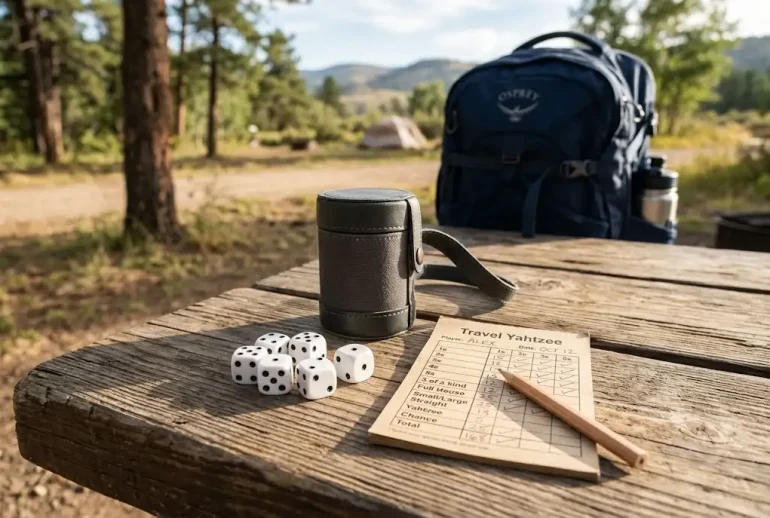
The appeal of this classic dice game lies in its combination of luck, decision-making, and friendly competition. Players roll five dice, choose which results to keep, and try to complete scoring combinations before their opponents. The travel edition focuses on convenience by keeping the essential components together in a smaller, easier-to-pack design.
This guide explains how Travel Yahtzee works, how to score points, what to look for when choosing a portable set, and how to enjoy the game during different types of trips.
What Is Travel Yahtzee?
Travel Yahtzee is a portable version of the classic Yahtzee dice game. It retains the central gameplay of rolling five dice to achieve particular combinations while adapting the equipment for easier transportation and storage.
Traditional board games can require several pieces, a large playing area, and careful packing. A travel-friendly dice game is generally simpler to manage because its main components can fit inside a compact container, cup, tray, or carrying case. The exact design depends on the edition.
A typical portable set may include:
- Five dice used to create scoring combinations.
- A dice cup, enclosed roller, or compact rolling tray.
- Scorecards for recording each player’s results.
- A pencil or another way to record scores.
- Instructions explaining the rules and scoring categories.
- A storage case or container that helps keep the components together.
Not every edition includes all these items, so check the product contents before purchasing. The most important features are secure dice storage, convenient scorekeeping, and a rolling mechanism that suits the places where you plan to play.
Why Travel Yahtzee Is Useful for Trips
Compact and easy to pack
A portable dice game takes up relatively little room compared with many traditional tabletop games. It can fit into a daypack, family travel bag, or luggage compartment, making it convenient for travelers who want entertainment without carrying bulky equipment.
Choose a set with a secure lid or enclosed dice mechanism if you want to minimize the chance of losing small pieces. Keeping the scorecards and pencil inside the same case also makes the game easier to find when you need it.
Simple to learn and play
The basic rules are straightforward: roll the dice, decide which results to keep, and select a scoring category. New players can learn the essentials quickly, while experienced players can focus on probability, risk, and decisions about when to stop rolling.
Because the game uses a limited number of components, it can be a practical option for family gatherings and casual game sessions. Players should check the age guidance supplied with their particular edition and supervise younger children around small dice.
A break from screens
Travel often involves waiting between activities, spending time at accommodation, or taking breaks during a longer journey. A physical dice game offers a way to spend that time with friends and family without relying on a phone, internet connection, or battery power.
It can also encourage conversation and friendly competition. The shared experience of trying for a large straight or a five-of-a-kind gives players something to enjoy together, even when they are not sightseeing.
How to Play Travel Yahtzee
Travel Yahtzee generally follows the standard Yahtzee rules. Some editions may use special components or variations, so the instructions supplied with your set should take priority if they differ from the standard rules.
Step 1: Prepare the game
Give each player a scorecard and something to write with. Place the five dice in the cup or rolling device, and make sure everyone can see the scoring categories. Decide who will take the first turn.
If you are playing in a confined space, arrange the scorecards and dice so that everyone can participate comfortably. A tray or enclosed roller can help keep the dice contained on a small table.
Step 2: Roll the five dice
On your turn, roll all five dice. Examine the results and decide which dice you want to keep. You might hold onto matching numbers, retain a sequence that could become a straight, or keep a mixture that offers several possible scoring options.
Step 3: Keep selected dice and roll again
You can generally roll up to three times during a turn, including the initial roll. After the first or second roll, set aside any dice you want to keep and reroll the others. You can also stop early if you are satisfied with your result.
For example, if your first roll contains three dice showing the same number, you might keep those dice and reroll the remaining two to try to complete four-of-a-kind or five-of-a-kind. The outcome is never guaranteed, so every decision involves some uncertainty.
Step 4: Choose a scoring category
After your final roll, choose one unused category on your scorecard and enter the appropriate score. You must fill a category each turn, even when your dice do not produce a useful combination. Depending on the category you choose, that turn may result in zero points.
Once a category has been filled, you cannot use it again during that game. This makes category selection important: a modest score now may be preferable to risking a valuable category on a result that is difficult to achieve.
Step 5: Complete the scorecard
A standard game contains 13 scoring categories per player. Continue taking turns until every player has completed their scorecard. Add the category scores and any applicable bonuses according to the rules, then compare the totals. The player with the highest final score wins.
Travel Yahtzee Scoring Categories Explained
Understanding the scoring categories helps players make better decisions during each turn. Standard Yahtzee divides its scorecard into upper and lower sections.
Upper-section categories
The upper section has one category for each number from one through six. You score the total of all dice showing the selected number.
- Aces: Add together all dice showing one.
- Twos: Add together all dice showing two.
- Threes: Add together all dice showing three.
- Fours: Add together all dice showing four.
- Fives: Add together all dice showing five.
- Sixes: Add together all dice showing six.
In standard scoring, earning a total of at least 63 points in the upper section qualifies the player for a 35-point bonus. This creates an additional reason to consider how the number categories contribute to the overall score.
Lower-section categories
- Three of a Kind: Score the sum of all five dice when at least three show the same number.
- Four of a Kind: Score the sum of all five dice when at least four show the same number.
- Full House: Score 25 points for a combination containing three of one number and two of another.
- Small Straight: Score 30 points for a sequence of four consecutive numbers.
- Large Straight: Score 40 points for a sequence of five consecutive numbers.
- Yahtzee: Score 50 points when all five dice show the same number.
- Chance: Score the sum of all five dice, regardless of their combination.
These are the standard category values. Additional Yahtzee bonuses and special rules may apply when a player rolls another five-of-a-kind, depending on the edition and the scorecard instructions.
Practical Strategies for Better Scores
Dice games always involve luck, but thoughtful choices can help you use your rolls more effectively. The aim is not to predict an exact result; it is to make the best decision with the dice available.
Keep your strongest combinations
When several dice already contribute to a promising combination, consider keeping them rather than rerolling everything. Three matching dice may offer a chance at four-of-a-kind or Yahtzee, while a sequence of consecutive numbers may be worth developing into a straight.
Think about the remaining scorecard
Look beyond the points available on the current turn. If a difficult category remains unfilled, consider whether the present roll is a reasonable opportunity to complete it. At other times, filling an easier category can protect you from losing a potentially valuable scoring opportunity later.
Use Chance thoughtfully
The Chance category can be useful when a roll does not fit another available category well. Since it scores the sum of all five dice, it can help preserve a stronger category for a future turn. However, the best choice depends on the rest of your scorecard.
Accept that a zero can be strategic
Sometimes, none of the available options produces a satisfying score. Rather than making a poor decision solely to avoid a zero, consider which category is least valuable to sacrifice. A difficult choice is part of what makes the game engaging.
What to Look for When Choosing a Portable Yahtzee Set
Not every travel edition is equally convenient. Think about how you intend to carry and use the game before choosing a set.
Secure dice storage
Loose dice can disappear into luggage pockets or fall onto the floor during a journey. Look for a case, cup, or enclosed roller that holds the components securely when the game is packed away.
A practical rolling surface
A contained rolling tray or enclosed mechanism can make the game easier to manage in limited space. This is especially useful when playing at a small table or in accommodation where loose dice could roll off the edge.
Readable scorecards
Scorecards should be easy to understand and large enough for comfortable writing. If the set includes a limited supply of score sheets, check whether replacements are available or whether you can use a compatible scorecard.
Durable construction
A travel game may be packed and unpacked repeatedly. Check the case hinges, lid, dice, and storage compartments for signs of flimsy construction. A design that stays closed in a bag is more practical than one that spills its contents whenever it is moved.
Appropriate size and weight
Smaller is not always better. Extremely tiny components can be difficult to handle or read, particularly for younger players and people with limited dexterity. Choose a balance between portability and comfortable gameplay.
Clear instructions and complete components
Make sure the game includes the necessary instructions and enough equipment for the number of people who will play. If you are buying a used set, check that the dice, scorecards, and rolling components are present and usable.
Where to Enjoy Travel Yahtzee During a Trip
Road trips and overnight stops
Travel Yahtzee can be a welcome activity during rest stops, at a picnic table, or after arriving at your accommodation. Keep the game accessible in your luggage so you can play when everyone has time to relax. Never handle dice or play a tabletop game while driving; the driver must remain focused on the road.
If you are planning a longer journey, destination guides such as places to visit in two days can help you think about how to balance sightseeing with relaxed downtime.
Family holidays
A compact dice game can be useful when different family members need a break from busy itineraries. Families planning activities can explore family places to visit in Metro Manila or unique places to visit in Tagaytay with family, then keep a small game available for quieter moments between outings.
For travelers with children, family-friendly activities in Rhode Island can also provide ideas for planning a trip with a mixture of outdoor activities and downtime.
Camping and outdoor breaks
After hiking or exploring outdoors, a dice game can provide a simple evening activity. Use a stable, dry surface and keep all pieces contained. Avoid playing in strong wind, where loose scorecards and dice may be difficult to control.
Travelers who enjoy natural scenery may find inspiration in places to visit near Banff National Park, places near Great Sand Dunes National Park, or places to visit in the Smoky Mountains of Tennessee.
City breaks and sightseeing holidays
City trips often include periods of waiting, time at a hotel, or a quiet evening after sightseeing. A portable game can be a convenient way to relax without adding another scheduled activity to the itinerary.
For inspiration, explore places to visit in Portland at night, free places to visit in San Francisco with scenic views, or places to visit near Victoria Station in London.
Seasonal holidays
Weather and daylight can influence how you spend time during a vacation. A compact indoor game can be useful when outdoor plans change or you simply want a break from sightseeing.
Consider travel inspiration from summer destinations in Croatia, winter destinations in Germany, places to visit in Oman during summer, or summer destinations in the United Kingdom.
For a broader international itinerary, places to visit in Sweden and Norway, destinations in Southeast Asia, and scenic and cultural destinations around the world offer further ideas for planning a trip where a compact game could come in handy.
Tips for Playing Travel Yahtzee in Shared Spaces
A portable design does not automatically make every location suitable for playing. A little consideration helps keep the experience enjoyable for everyone nearby.
- Choose an appropriate location: Use a table or designated seating area rather than blocking walkways or shared facilities.
- Keep the noise down: Roll gently or use an enclosed dice mechanism in quiet accommodation and shared indoor spaces.
- Keep components together: Return the dice and scorecards to their case after each session.
- Respect other travelers: Avoid taking up more space than necessary and follow the rules of the venue or transport provider.
- Protect the scorecards: Keep paper dry and use a flat surface for writing.
- Supervise children: Small dice and other pieces should be kept away from young children who may put them in their mouths.
Travel Yahtzee Compared With Other Portable Games
Travel Yahtzee is one option among many compact games. The best choice depends on the size of your group, how much space you have, and whether you prefer luck, strategy, words, or conversation.
| Game type | Main appeal | What to consider |
|---|---|---|
| Travel Yahtzee | Dice combinations, probability, and scorekeeping | Requires dice and a scorecard or scoring method |
| Playing cards | Many possible games in a compact package | Players need to agree on a particular card game |
| Travel word games | Vocabulary, creativity, and quick thinking | Some versions require paper or a way to record answers |
| Compact board games | More structured strategy and varied mechanics | Pieces and boards may require additional table space |
| Mobile games | Convenient solo play and digital scoring | May require a charged device, and some features need internet access |
For travelers who value a familiar ruleset and physical interaction, Travel Yahtzee can be a practical choice. Those who want more variety might prefer a deck of cards or a compact collection of different games.
Frequently Asked Questions About Travel Yahtzee
Is Travel Yahtzee different from regular Yahtzee?
The core gameplay is generally the same. The main difference is the physical design, which is adapted for storage and transportation. Always check the instructions for your particular edition because components and special features can vary.
How many dice do you need to play?
Standard Yahtzee uses five dice. A travel edition normally includes the same number, although a particular themed or electronic version may use a different physical format.
Can you play Travel Yahtzee alone?
Yes. Standard Yahtzee can be played as a solo game in which you try to achieve your best possible score. You can also play with other people and compare final totals.
How long does a game take?
The duration depends on the number of players, how quickly they make decisions, and whether everyone completes a full scorecard. A short session is possible if you agree on a limited number of rounds, but that changes the standard game format.
Is Travel Yahtzee suitable for children?
It can be a family-friendly activity for children who are ready to understand the rules and manage the components safely. Check the age recommendation on the package and supervise young children around small pieces.
Can you play Travel Yahtzee on a plane?
You may be able to play during a flight when the seat-table space is available and the crew permits it. An enclosed dice roller is useful because it helps prevent dice from falling or disturbing nearby passengers. Follow crew instructions and keep your belongings within your designated space.
What should you look for in a travel edition?
Look for secure storage, readable scorecards, durable components, clear instructions, and a rolling surface or mechanism that works in confined spaces. Choose a size that is easy to carry without making the dice or scoring areas difficult to use.
Does Travel Yahtzee require an internet connection?
A traditional physical set does not require an internet connection or batteries for its standard gameplay. Electronic editions may have different requirements, so check the product information for the specific version you own.
Final Thoughts
Travel Yahtzee combines familiar dice gameplay with a compact design that makes it convenient to bring along on trips. Its straightforward rules, mix of luck and decision-making, and simple equipment make it suitable for relaxed game sessions with friends or family.
For the best experience, choose a portable set with secure storage, keep the scorecards and dice together, and play in a suitable location where everyone has enough space. Whether you are relaxing after sightseeing, spending an evening at your accommodation, or taking a break during a family holiday, a small dice game can provide an enjoyable alternative to screen-based entertainment.