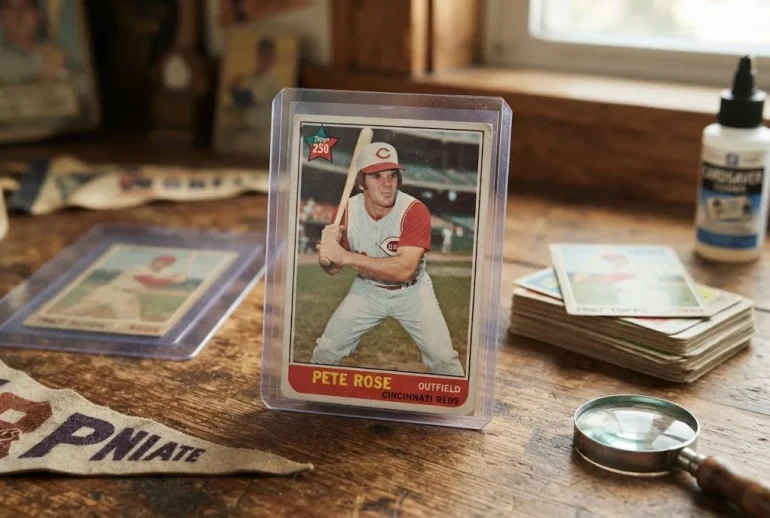
For collectors, the appeal is not simply the player’s name. The card also represents a specific point in Rose’s career, has a distinctive vintage design, and can show substantial differences in value depending on condition and professional grading. PSA’s current card data identifies the issue as 1968 Topps #230 and tracks examples across multiple grades, illustrating how strongly condition affects the market. PSA’s 1968 Topps Pete Rose card record provides current grading and population information for collectors researching the issue.
What Is the 1968 Topps Pete Rose Card?
The 1968 Topps Pete Rose card is numbered #230 in the regular Topps baseball set. It features Rose as a member of the Cincinnati Reds and belongs to a 1968 set remembered for its distinctive vintage visual style.
The card is not a rookie card. Instead, its significance comes from its place in Rose’s early-career cardboard history and from the player’s long-term importance to baseball collecting.
The broader 1968 Topps set contains 598 cards and includes several major stars and notable rookie cards. Pete Rose #230 is one of the key veteran cards collectors commonly associate with the set.
Why Collectors Pay Attention to Pete Rose #230
Pete Rose cards have remained recognizable within the vintage baseball-card hobby because of the player’s extraordinary statistical career and long association with the Cincinnati Reds. The 1968 issue is particularly interesting because it captures Rose during the late 1960s rather than during the later stages of his career.
Collectors may be drawn to this card for several reasons:
- It is a vintage Topps baseball card from 1968.
- It features Pete Rose in a Cincinnati Reds uniform.
- It represents an important period in Rose’s playing career.
- The card belongs to a well-known vintage Topps set.
- High-grade examples are considerably harder to find than heavily worn copies.
- It can complement a chronological Pete Rose card collection.
For someone building a player-focused collection, the card can also be viewed alongside later Rose issues. NovasPath’s related 1983 Pete Rose Topps card article provides another point of comparison for collectors following Rose’s Topps card history.
The 1968 Topps Design
One of the card’s strongest visual characteristics is the distinctive design used by Topps in 1968. The set is known for its textured, burlap-style appearance, which gives the cards an immediately recognizable vintage character.
Unlike modern cards that often rely on glossy finishes, foil details, or elaborate graphics, 1968 Topps cards have a comparatively simple period design. The photograph, typography, borders, and team information work together to create a look that is strongly associated with late-1960s baseball cards.
That design also creates a challenge for collectors. The edges and corners can reveal wear relatively easily, meaning condition is particularly important when evaluating an example of Pete Rose #230.
Pete Rose’s Career Context in 1968
The card becomes more interesting when placed within Rose’s career timeline. Rose had already established himself as a productive Major League hitter by 1968, having debuted with the Cincinnati Reds earlier in the decade.
During the 1968 season, Rose hit .335 and won the National League batting title. That achievement helped reinforce his reputation as one of the game’s premier contact hitters and added historical significance to cards depicting him from this period.
Rose’s overall career eventually included 4,256 Major League hits, 17 All-Star selections, and three World Series championships. He finished his career as MLB’s all-time leader in hits, games played, plate appearances, and at-bats.
His baseball legacy is also complicated by his permanent ineligibility from Major League Baseball following his agreement with baseball in 1989 concerning allegations that he bet on baseball games. That part of his history is relevant to collectors because Rose’s memorabilia has continued to attract attention while his place in official baseball institutions remains a subject of debate.
1968 Topps Pete Rose Card Value
The value of a 1968 Topps Pete Rose #230 depends heavily on the individual card. There is no single price that applies to every copy.
Important variables include:
- Overall condition
- Professional grading
- Centering
- Corner sharpness
- Surface quality
- Print quality
- Edges
- Authenticity
- Recent comparable sales
- Current collector demand
Current PSA CardFacts data shows a wide spread between grades. The page records recent prices ranging from lower-dollar examples in heavily worn grades to several thousand dollars for high-grade copies, with the highest-grade population being especially limited. Because auction activity and market conditions change, collectors should treat individual sales as historical indicators rather than guaranteed future prices.
For example, PSA’s current data records a recent $3,494 sale for a PSA 9 example and a $26,100 most recent price entry for a PSA 10 example. The same database reports only a small number of PSA 10 examples compared with substantially larger populations in lower grades. These figures demonstrate why grade can have a dramatic effect on the value of vintage cards.
Condition: The Biggest Factor in Value
Condition is one of the most important considerations when buying or selling a 1968 Topps Pete Rose card. A card that looks attractive in a photograph may reveal problems when examined closely.
Centering
Check the borders around the card and compare the left-to-right and top-to-bottom spacing. Strong centering can make a vintage card more visually appealing and may contribute to a higher grade.
Corners
Look closely at all four corners. Softness, rounding, bends, or visible whitening can reduce the condition grade.
Edges
Vintage card edges can show chipping, discoloration, or other signs of handling. Examine them under good lighting rather than relying only on a front-facing photograph.
Surface
Scratches, creases, stains, print defects, writing, and other surface problems can affect both eye appeal and grading potential.
Creases and Paper Damage
A visible crease can have a major impact on grade. Collectors should also watch for paper loss, wrinkles, trimming, or evidence that the card has been altered.
Raw vs. Graded 1968 Pete Rose Cards
Collectors generally encounter this card in two broad forms: raw cards that have not been professionally graded and encapsulated cards that have been evaluated by a grading company.
A raw card may be appropriate for collectors who primarily care about the card itself, but assessing condition accurately requires experience. A seemingly clean card can still have centering, surface, or structural issues that become apparent under magnification.
A professionally graded example provides a standardized condition assessment and an authentication record associated with the grading company’s certification system. However, collectors should still inspect the card and certification information carefully rather than assuming that every graded example is equally attractive.
How to Authenticate a 1968 Topps Pete Rose Card
Authentication matters whenever a vintage card has meaningful collector value. Before buying an expensive example, examine the seller, photographs, card details, and any available certification information.
For graded cards, verify the certification number through the relevant grading company’s database when that service is available. Compare the certification information with the physical card and look for inconsistencies.
For raw cards, authentication can be more difficult. Collectors should pay particular attention to trimming, altered surfaces, unusual dimensions, reprints, and other potential modifications.
Where Collectors Can Find the Card
The 1968 Topps Pete Rose #230 can appear through several channels, including online marketplaces, sports-card auction platforms, vintage card dealers, local card shops, shows, and private collections.
When comparing listings, do not focus solely on the asking price. Compare the card’s condition, centering, grading status, seller reputation, photographs, and recent comparable sales.
For graded examples, compare cards at the same grade whenever possible. A PSA 7, PSA 8, and PSA 9 should not be treated as interchangeable simply because they depict the same card.
What to Look for Before Buying
A practical buying checklist can help prevent costly mistakes.
- Confirm the card number: Make sure the card is the regular 1968 Topps Pete Rose #230 rather than another Rose issue from the same year.
- Inspect the front and back: Look for creases, stains, writing, trimming, and other defects.
- Evaluate centering: Compare the visible borders on all sides.
- Check the corners and edges: Vintage wear is often easiest to identify in these areas.
- Review grading information: If the card is graded, verify the certification details.
- Compare recent sales: Use sales of similar grades and comparable condition rather than unrelated listings.
- Consider the seller: Established dealers and reputable auction platforms can provide additional buyer protections.
- Avoid pressure purchases: A collectible should be evaluated on its actual condition and market evidence rather than urgency.
How to Store a 1968 Topps Pete Rose Card
Proper storage can help protect a vintage card from further deterioration. Cards should be kept away from excessive moisture, direct sunlight, heat, and environments with large temperature fluctuations.
For valuable examples, collectors may use a protective holder or professionally sealed slab. Raw cards can be placed in appropriate archival-quality protective materials before being stored securely.
Avoid repeatedly removing a card from its holder or handling its surface with bare hands. Even when a card is inexpensive, unnecessary handling can create avoidable damage over time.
Building a Pete Rose Topps Collection
The 1968 card can serve as one part of a broader Pete Rose collection. Rather than collecting only one year, some collectors build a chronological run covering different stages of Rose’s career.
A collection can include early-career Topps cards, later Cincinnati Reds issues, Philadelphia Phillies cards, specialty issues, and other officially produced memorabilia. Collectors may choose to focus on a particular decade, grading range, design style, or career milestone.
Comparing the 1968 issue with the 1983 Pete Rose Topps card is one way to see how Rose’s cardboard presence changed over the course of his career.
Is the 1968 Topps Pete Rose Card a Good Collectible?
The answer depends on what a collector wants from the card. It has clear historical and hobby relevance because it combines a major baseball figure, a recognizable vintage Topps set, and a period from Rose’s playing career that remains important to baseball-card collectors.
However, collectors should separate historical interest from financial expectations. A vintage card’s future market performance cannot be guaranteed. Prices can change according to grade, supply, demand, auction activity, broader collecting trends, and the specific characteristics of an individual copy.
For collectors primarily interested in baseball history, the card can be appreciated as a physical connection to the late 1960s. For condition-focused collectors, high-grade examples offer a different challenge because preserving sharp corners, strong centering, and clean surfaces is considerably harder with vintage cardboard.
Frequently Asked Questions
What card number is Pete Rose in the 1968 Topps set?
Pete Rose’s regular 1968 Topps card is #230.
Is the 1968 Topps Pete Rose card a rookie card?
No. The 1968 Topps Pete Rose #230 is not a rookie card. Rose’s Major League career began earlier in the 1960s.
Why does condition matter so much for this card?
Vintage cards naturally accumulate wear over decades. Centering, corners, edges, surface condition, creases, and alterations can create substantial differences between otherwise identical cards.
Can a 1968 Topps Pete Rose card be worth thousands of dollars?
Yes, high-grade examples can command prices in the thousands. Current grading and sales data shows a substantial difference between lower-grade and high-grade examples, although actual prices vary over time.
Should I buy a raw or graded Pete Rose card?
That depends on your collecting goals. A raw card may suit collectors who are comfortable evaluating condition, while a professionally graded card provides a standardized grade and encapsulation.
How should I store the card?
Keep it protected from moisture, direct sunlight, excessive heat, and unnecessary handling. A suitable protective holder can reduce the risk of physical and environmental damage.
Final Thoughts
The 1968 Topps Pete Rose #230 remains an interesting vintage baseball card because it brings together Pete Rose’s early-career history, Cincinnati Reds identity, and one of Topps’ most recognizable 1960s designs.
For collectors, the most important step is to evaluate the individual card rather than relying on the name or year alone. Condition, authenticity, centering, grading, and comparable sales all matter when determining what a particular example may be worth.
Whether the goal is to build a complete Pete Rose collection, assemble a vintage Cincinnati Reds collection, or simply own an important 1960s baseball card, #230 offers a clear connection to an important period in the history of the sport and the hobby.